
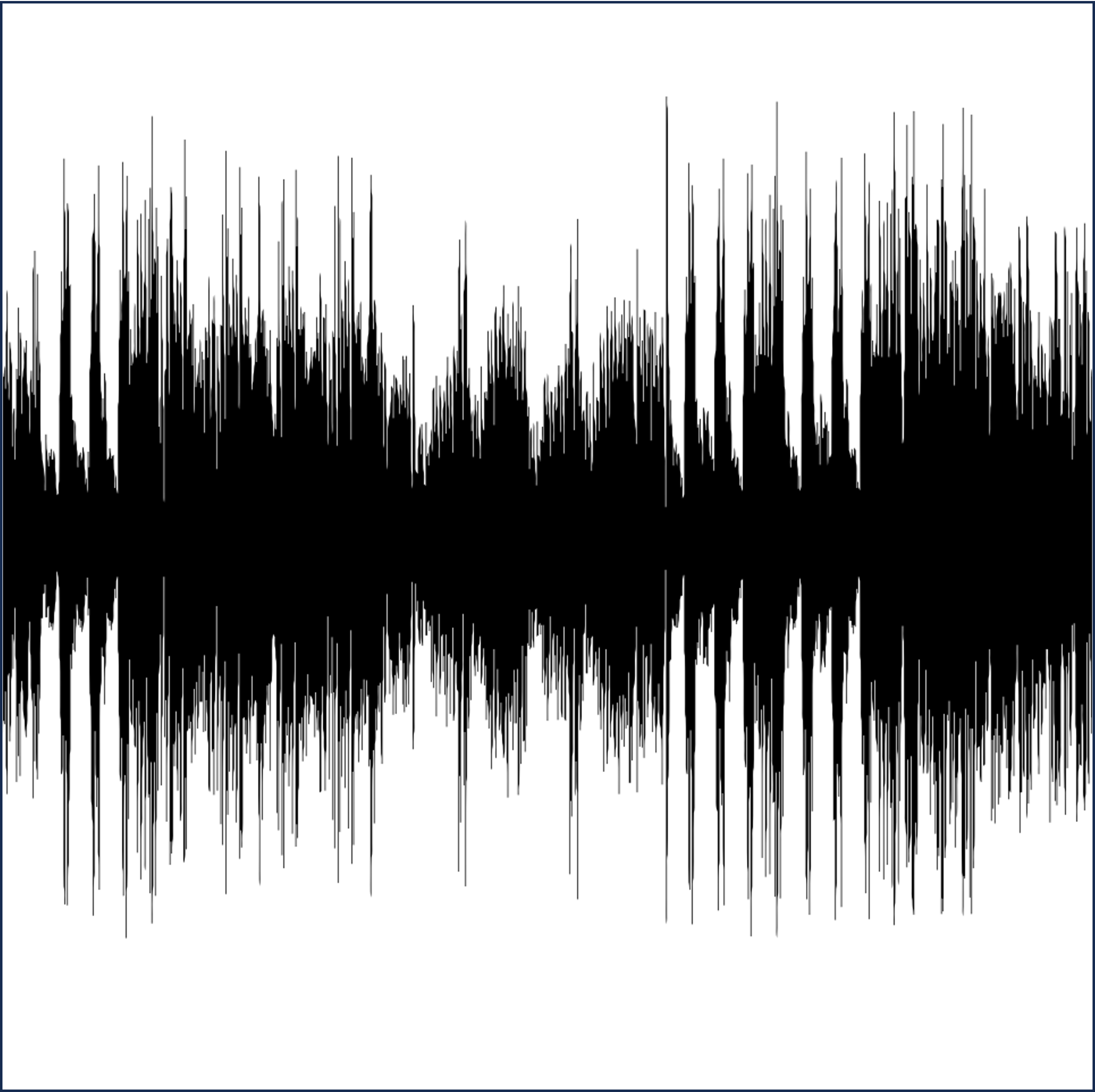

When energy passes through a medium resulting in a wave-type motion, several different types of waves may be generated, depending upon the motion of a particle in the medium. A transverse wave occurs when its amplitude varies in the direction normal to the direction of the propagation. This type of wave has been used to describe the transmission of light and alternating electric current. But the situation is almost completely different in the case of sound waves, which are principally longitudinal, in that the particles oscillate back and forth in the direction of the wave motion, with the result the motion creates alternative compression and rarefaction of the medium particles as the sound passes a given point. The net fluid displacement over a cycle is zero, since it is the disturbance rather than the fluid that is moving at the speed of sound. The fluid molecules do not move far from their original positions.
Waves may also fall into the category of being rotational or torsional. The particles of a rotational wave rotate about a common center; the curl of an ocean wave roaring onto a beach provides a vivid example. The particles of torsional waves move in a helical fashion that could be considered a vector combination of longitudinal and transverse motions. Such waves occur in solid substances, and shear patterns often result. These are referred to as shear waves, which all solids support.
The concept of simple sinusoidal waves lacks specificity to be of practical value in noise control, but complex periodic waveforms can be broken into two or more sinusoidal harmonically related waves. A complex waveform resolves into a sum of harmonically related waves. The harmonic relationship in this example is such that the frequency of one harmonic is twice that of the other. The lowest-frequency sine term is the fundamental, and the next highest frequency the second harmonic, the next the third harmonic, and so on. Sound pressure waves radiating from pumps, gears, and other rotating machinery are usually complex and periodic, with distinguishable discrete tones or pure tones. These sinusoidal waves can be broken down or synthesized into simple sinusoidal terms. In the analysis of the noise emanating from rotating machinery, there are often 8 to 10 harmonics present with frequencies which are integer-ordered multiples of the fundamental frequency. Even aperiodic sounds such as the hiss of a pressure valve of an autoclave, the broadband whine of a jet engine, or the pulsating sound of a jackhammer can be resolved and described in terms of sums of simple sinusoids.
When a sound wave is superposed upon another wave of the same frequency but traveling in a different direction, a standing-wave sound field is generated.
The transmission of the sound through the fluid results in low values of spatial temperature gradients at audio frequencies, resulting in almost no heat transfer between warmer and cooler regions of the plane wave. Thus the ongoing thermodynamics process may be considered an adiabatic process (at ultrasonic frequencies there is virtually no time for heat transfer to occur).
Huygens’ principle applies equally to sound propagation. The principle states that advancing wavefronts can be considered to be point sources of secondary wavelets.
When sound impinges upon a surface, a portion of its energy is absorbed by the surface and the remainder bounces back or becomes reflected from the surface. A perfectly hard surface will reflect back all of the energy. A classic example of the reflection phenomenon is the echo which has intrigued and mystified humanity for centuries.
A phenomenon more familiar in optics than in acoustics is that of refraction, in which the direction of the advancing wavefront is bent away from the straight line of travel. Refraction occurs as the result of the difference in the propagation velocity as the wave travels from one medium to a different medium.
Diffraction of sound waves is the phenomenon where sound waves bend around obstacles or spread out after passing through narrow openings. This bending occurs because sound waves have wavelengths comparable to everyday objects and openings, making diffraction easily observable in our daily lives.
Ultrasound imaging
[1]. Raichel, D.R., 2006. The science and applications of acoustics. Springer Science & Business Media.
[1]. Raichel, D.R., 2006. The science and applications of acoustics. Springer Science & Business Media.
